In strategic planning sessions for small and mid-sized P&C carriers, "digital simplification" is a common goal. The logic is sound: strip away the complexity of legacy systems to make the team faster and the customer experience smoother.
But there is a counter-intuitive reality in insurance operations: Oversimplified technology often creates hidden organizational drag.
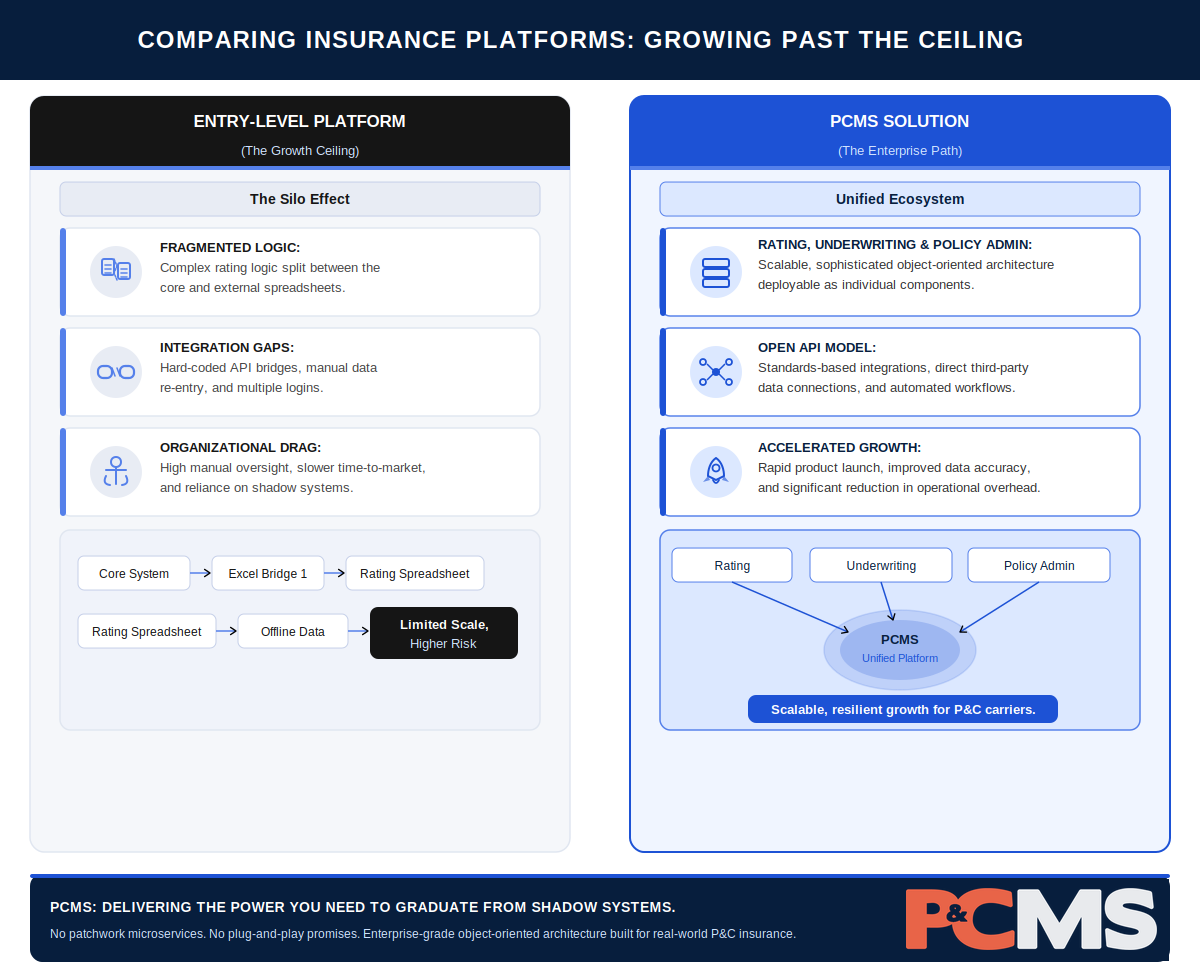
When a core system is “simple” because it lacks deep-tier functionality, the complexity doesn’t actually disappear. It simply migrates. It moves off the software and onto the desks of your underwriters and billing clerks—the very people who should be focused on rating, underwriting, and policy administration, not compensating for software gaps.
The Migration of Complexity
When a system hits its functional ceiling, your team subconsciously builds a "shadow system" to keep the business moving. You can spot this in three specific areas:
- The Manual Bridge: If your team is re-keying data from an agent portal into a core system, or using Excel to calculate multi-state premiums, they are acting as the "manual bridge" for a system that cannot talk to itself.
- The Expert Bottleneck: When a process only works because one specific person knows the "trick" to get the software to accept a certain risk, you haven't simplified—you’ve created a single point of failure.
- The "Not Yet" Culture: When the first response to a new market opportunity is "our system can’t handle that rating logic," your technology is no longer an asset. It is a governor on your growth.
Technical Debt vs. Operational Resilience
Every workaround your team creates is a form of Technical Debt. Similar to financial debt, it carries an interest rate. In insurance, that interest is paid in Time-to-Market and Loss Ratio Accuracy.
A truly resilient carrier doesn’t just look for “simple” tools—and they don’t fall for the promise of endless microservice plug-and-play complexity that sounds innovative but adds integration overhead, security risk, and operational fragility. They look for Enterprise Strength refined for agility: a scalable, sophisticated object-oriented architecture where each core function—rating, underwriting, and policy administration—operates as a cohesive, individually deployable component. Think of it as a unified platform you can leverage as a whole or engage by discipline, without sacrificing the integrity of the system. This means prioritizing:
- Unified Data Schemas: Where rating, underwriting, and policy administration all share the same “truth” in the database—eliminating the data silos that force manual reconciliation.
- Open API Architecture: A standards-based Open API model that allows you to plug in a new hazard data provider, rating feed, or analytics tool in days—not months—without expensive custom development or vendor lock-in.
- Deep Domain Expertise: Partnering with people who understand the difference between a "glitch" and a statutory filing requirement.
- Modular Component Architecture: Think of it like a high-performance engine—every component is precision-engineered to work as part of the whole, but each can be accessed, tuned, or deployed independently. Rating. Underwriting. Policy Administration. Each a capable module; together, an enterprise-grade platform. That’s not a microservice patchwork. That’s sophisticated object-oriented design built for the real world of P&C insurance.
The "Growth Anchor" Diagnostic: Is Your Technology Holding You Back?
Use this 5-point checklist to determine if your current operations are built for scale or if you are simply managing limitations.
- The "Vacation" Test: If your lead underwriter went on a two-week vacation today, would a critical process like a state filing or complex renewal come to a complete halt?
- The "Double-Entry" Audit: Does your team have to type the same policyholder information into more than one system (e.g., from an agent portal into your core suite)?
- The "Not Yet" Reality Check: In the last six months, have you delayed a new product launch because the system "couldn't handle the rating logic"?
- The Spreadsheet Count: How many critical business decisions are being made using data pulled manually into Excel because your core system can’t generate the report in real time?
- The Integration Wall: When you want to add a new third-party data tool (like hazard maps), does your vendor tell you it will take 6+ months and a massive custom fee to "plug it in"?
How Did You Score?
If you checked 2 or more boxes, your current technology is likely an anchor, not an engine. It may be time to move toward a Real Enterprise Suite that scales with your ambition.
A Question for Your Next Leadership Meeting
Instead of asking, "Is our software easy to use?" try asking, "Is our software actually doing the work, or is our team working to support the software?"
The answer to that question will tell you if you are managing a platform or managing a limitation. The goal of modernization isn't just to replace a screen; it’s to reclaim the organizational capacity currently being drained by "simple" technology.
Ready to Get Real?
Let PCMS Atlas help you stop managing limitations and start managing growth with technology built for the real world.