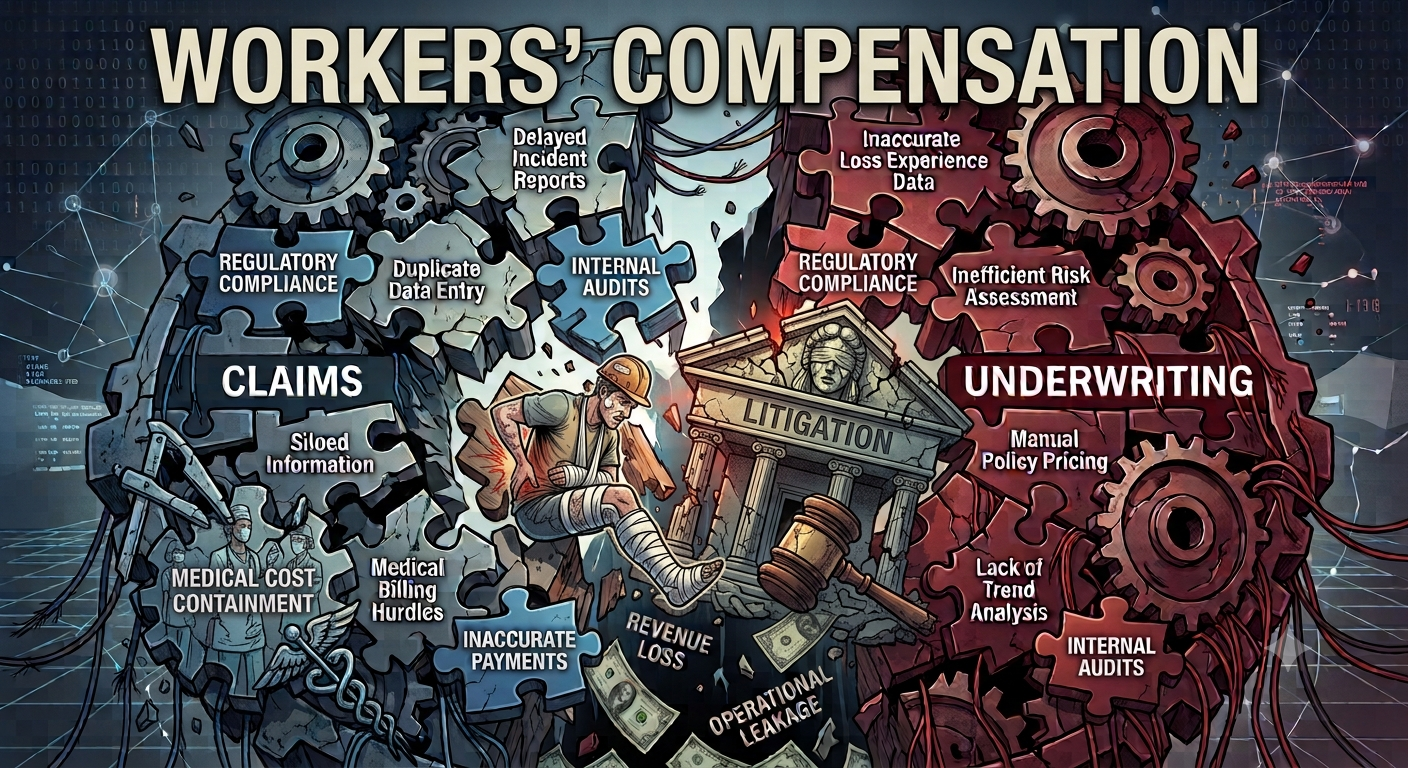
Ask a workers’ compensation executive what’s driving costs higher and you’ll likely hear the usual list: medical inflation, increasingly complex claims, attorney involvement, regulatory pressure. They’re not wrong. But there’s another cost buried underneath many of those challenges that rarely gets the same attention, because it never shows up as a single line item. It’s the cost of disconnected workflows — and it surfaces everywhere at once: adjusters re-entering information that already exists elsewhere, duplicate claimant records, spreadsheets that exist only because two systems don’t talk to each other, compliance deadlines someone has to remember instead of the system managing automatically. None of that looks catastrophic on its own. Together, it’s a steady drain on productivity, data quality, service, and profitability — harder to ignore as carriers try to grow without growing overhead at the same pace.
Three Goals Every Carrier Shares
Every worker’s compensation carrier is different, but most are ultimately chasing the same three outcomes:
• Move claims faster
• Deliver better service
• Maintain quality and compliance
These goals are more connected than they seem. When information flows easily between teams, vendors, and systems, claims are processed quicker, service gets better, and documentation becomes more accurate — almost automatically. Interrupt that flow, and the reverse occurs just as consistently: cycle times elongate, customers experience longer wait times, errors emerge, and compliance risk increases. It's important to note this pattern: most issues in workers' compensation operations stem from the same underlying problem — information isn't flowing as it should.
Where the Friction Actually Happens
Anyone who’s worked on a claim has seen this. Information gets entered into the claims system, then a nurse case manager needs the same details in a separate managed-care platform, a bill review vendor works from its own portal, and the TPA keeps a record that may or may not be current. Several systems end up holding the same claim, and everyone assumes someone else has the latest version.
Nobody planned it this way — it’s the byproduct of years of reasonable, one-at-a-time decisions: a vendor added to solve a specific problem, a tool picked because IT had a backlog, a new system layered on an old one instead of replacing it. None of it happens because people are doing anything wrong; it happens because no one was ever responsible for making the pieces talk to each other, so people became the integration layer instead — adjusters manually transferring information from one screen to another, which is a strange task for someone employed to handle claims rather than to move data.
The same pattern shows up in underwriting, policy administration, and finance: the inherited spreadsheet everyone depends on, the hand-built monthly reconciliation, the process that only works because one person remembers all the exceptions. These workarounds keep the business running, but they’re a sign operating knowledge lives in people’s heads and spreadsheets instead of any system — and that doesn’t scale. Add growth, and the workaround that once required an afternoon each month now consumes a week.
The Problem with Duplicate Records
Disconnected systems create a second-order cost: duplicate data. Every manual transfer between systems is a chance for something to get entered differently — a name formatted differently, an address that’s changed, a blank field, a mismatched identifier — and over time, duplicate and near-duplicate records pile up.
The obvious duplicates get caught. The harder problem is the “soft duplicate”: a record that clearly represents the same claimant or claim but differs just enough to slip past automated matching. Research into this specific problem in workers’ comp claim files found that roughly two-thirds of duplicate records fall into that category — meaning most detection tools catch only a minority of what’s actually there (Insurance Thought Leadership). The same reporting traces a real consequence to a single TPA that absorbed a $58,000 overcharge under a state medical-cost reimbursement program after duplicate records went undetected — an abstract data-quality issue turning into a real check written for no reason.
Multiply that across a book of business and data quality stops being a technology footnote — it becomes an operational one, and once trust in the data erodes, every decision built on top of it gets harder.
The Cost Carriers Don’t See
The bigger cost isn’t the wasted time — it’s the visibility lost because information lives in separate places. Claims has one view of a claimant, managed care has another, underwriting has its own data, and payroll and vendor information sit somewhere else entirely. Everyone sees part of the picture; almost no one sees the whole thing.
That matters most on the claims most worth catching early. A return-to-work issue, an emerging medical complication, a treatment pattern, a litigation indicator — none of those signals mean much alone, but together they can be a clear sign that intervention is needed. The problem is that the signals usually live in systems owned by different groups, and by the time someone connects them, the window to act may already be gone.
When Operational Friction Becomes a Compliance Risk
Workers’ comp is already one of the most heavily regulated lines of insurance — every state has its own requirements, and deadlines and statutory obligations keep shifting. Yet many carriers still manage compliance with spreadsheets, email reminders, and manual tracking. That’s risky: a missed filing deadline isn’t just an inconvenience, it can become a regulatory finding, a penalty, or an audit issue. The more jurisdictions a carrier operates in, the harder that is to manage by hand — one reason is that more carriers are building compliance directly into operational workflows instead of relying on memory and spreadsheets.
What Real Integration Actually Looks Like
“Integration” sounds like a technology project, but the real value isn’t technology — it’s eliminating unnecessary work. Every time the same piece of information gets entered, updated, verified, or transferred over the life of a policy or claim, that’s a touchpoint, and every touchpoint is cost. Real integration removes those touchpoints: information enters the system once and becomes available everywhere it’s needed.
That’s the philosophy behind modern enterprise platforms such as PCMS Atlas, which is built on a shared core rather than separate functions stitched together with workarounds — combining policy administration, billing and accounting, claims management, reporting, and portal functionality on one unified platform. The result isn’t just faster processing; it’s fewer manual handoffs, better visibility, cleaner data, and an operation that scales.
Why APIs Matter More Than the Platform Itself
No carrier operates in a single-system environment — bill review vendors, managed care, payroll providers, TPAs, and regulators all need information, and the real question is whether those systems can talk to each other without people acting as the messenger. A modern API strategy lets claim status, payroll, and reporting data move automatically instead of being downloaded, reformatted, and re-uploaded by hand — less reconciliation work, fewer duplicate records, more confidence everyone’s working from the same information.
It’s also why PCMS Atlas puts such weight on open APIs: built to connect with external systems and partners while keeping a single operational core, so carriers gain connectivity without ripping out everything they already run (pcmstech.com/solutions). The goal isn’t eliminating every existing platform — it’s eliminating the gaps between them.
Why This Remains Difficult
If this were easy, the industry would have solved it years ago. Workers’ comp is genuinely complex — every jurisdiction has different requirements, vendor ecosystems are specialized, and regulations keep evolving. There will probably never be one platform that owns every process in a workers’ comp operation, which is why integration strategy matters more than platform selection. The most successful carriers aren’t standardizing everything overnight; they’re building reliable data flow between the systems that matter most, with strong governance over data quality. Increasingly, the harder problem isn’t technological — it’s organizational.
Building a More Connected Operation
Carriers don’t have to transform everything at once. The ones making the most progress start small — identifying the friction-heaviest handoffs, often carrier-to-TPA or claims-to-managed-care workflows — and connect those first. Once the business sees measurable improvement in cycle times or reporting quality, support for the next phase gets much easier to build. Proving value on one workflow before moving to the next builds both the technical foundation and the organizational momentum that enterprise-wide overhauls often lack.
The Bottom Line
The industry spends plenty of time on claim costs, medical trends, litigation, and regulation — and it should. But many carriers still underestimate the cost of disconnected work: every spreadsheet reconciliation, every duplicate record, every manual handoff, every piece of information entered more than once. None of it shows up in a single report, which is exactly why it’s so easy to live with.
Fixing it rarely requires a massive transformation project. The biggest gains usually come from fixing the highest-friction handoffs and improving data quality — whether through better point-to-point integrations or a connected platform like PCMS Atlas that combines core operations with API-driven connectivity. Either way, the goal is the same: less time moving information, more time acting on it.
Because in workers’ compensation, faster decisions, better service, stronger compliance, and lower costs often come down to one simple question:
How many times does the same piece of information have to be entered before somebody can actually use it?